Indicators
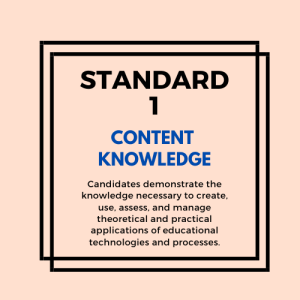
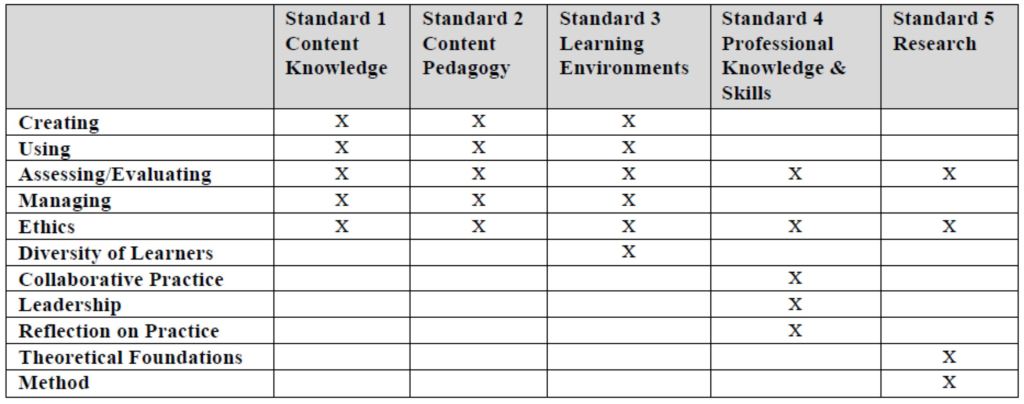
Creating -Candidates demonstrate the ability to create instructional materials and learning environments using a variety of systems approaches. (p. 81)1
Using -Candidates demonstrate the ability to select and use technological resources and processes to support student learning and to enhance their pedagogy. (p. 141)
Assessing/Evaluating -Candidates demonstrate the ability to assess and evaluate the effective integration of appropriate technologies and instructional materials.
Managing -Candidates demonstrate the ability to effectively manage people, processes, physical infrastructures, and financial resources to achieve predetermined goals. (p. 178)
Ethics -Candidates demonstrate the contemporary professional ethics of the field as defined and developed by the Association for Educational Communications and Technology. (p. 284)
Indicators
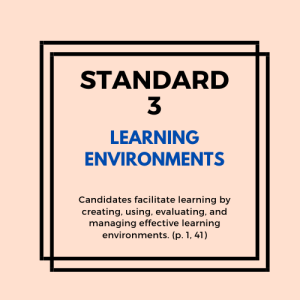
Creating -Candidates create instructional design products based on learning principles and research-based best practices. (pp. 8, 243-245, 246)
Using -Candidates make professionally sound decisions in selecting appropriate processes and resources to provide optimal conditions for learning based on principles, theories, and effective practices. (pp. 8-9, 122, 168-169, 246)
Assessing/Evaluating -Candidates use multiple assessment strategies to collect data for informing decisions to improve instructional practice, learner outcomes, and the learning environment. (pp. 5-6, 53)
Managing -Candidates establish mechanisms for maintaining the technology infrastructure to improve learning and performance. (p. 190, 234, 238)
Ethics -Candidates foster a learning environment in which ethics guide practice that promotes health, safety, best practice, and respect for copyright, Fair Use, and appropriate open access to resources. (p. 3, 246)
Diversity of Learners -Candidates foster a learning community that empowers learners with diverse backgrounds, characteristics, and abilities. (p. 10)

Indicators
Theoretical Foundations -Candidates demonstrate foundational knowledge of the contribution of research to the past and current theory of educational communications and technology. (p. 242)
Method -Candidates apply research methodologies to solve problems and enhance practice. (p. 243)
Assessing/Evaluating -Candidates apply formal inquiry strategies in assessing and evaluating processes and resources for learning and performance. (p. 203)
Ethics -Candidates conduct research and practice using accepted professional and institutional guidelines and procedures. (p. 296-7)


Indicators
Creating –Candidates apply content pedagogy to create appropriate applications of processes and technologies to improve learning and performance outcomes. (p. 1)
Using -Candidates implement appropriate educational technologies and processes based on appropriate content pedagogy. (p. 141)
Assessing/Evaluating -Candidates demonstrate an inquiry process that assesses the adequacy of learning and evaluates the instruction and implementation of educational technologies and processes grounded in reflective practice. (p. 116-117)
Managing -Candidates manage appropriate technological processes and resources to provide supportive learning communities, create flexible and diverse learning environments, and develop and demonstrate appropriate content pedagogy. (p. 175-193)
Ethics -Candidates design and select media, technology, and processes that emphasize the diversity of our society as a multicultural community. (p. 296)

Indicators
Collaborative Practice -Candidates collaborate with their peers and subject matter experts to analyze learners, develop and design instruction, and evaluate its impact on learners.
Leadership -Candidates lead their peers in designing and implementing technology-supported learning.
Reflection on Practice -Candidates analyze and interpret data and artifacts and reflect on the effectiveness of the design, development and implementation of technology-supported instruction and learning to enhance their professional growth.
Assessing/Evaluating -Candidates design and implement assessment and evaluation plans that align with learning goals and instructional activities.
Ethics -Candidates demonstrate ethical behavior within the applicable cultural context during all aspects of their work and with respect for the diversity of learners in each setting.
1 NOTE: Parenthetical page references are to Januszewski, A., Molenda, M., & Harris, P. (Eds.). (2008). Educational technology: A definition with commentary (2nd ed.). Hillsdale, NJ: Lawrence Erlbaum Associates.
References:
Association for Educational Communication and Technology. (2012). Retrieved from https://www.aect.org/docs/AECTstandards2012.pdf
 Janeal Grosinger